
For years, Bitcoin holders have relied on a familiar script.
Every four years, the halving cuts new supply in half. Price responds. Momentum builds. New capital enters the market. A bull cycle follows. Then comes excess, leverage, the blow-off top, and the inevitable reset. Repeat.
It is a clean story. It is intuitive. It is easy to remember.
It also may never have been the real driver.
That does not mean halvings do not matter. They do. Bitcoin’s fixed supply and declining issuance schedule are foundational to the asset. They are part of what makes Bitcoin different from fiat currencies, from commodities with elastic production, and from most other financial assets in the modern system.
But there is a difference between something being foundational and something being the primary driver of price. I’m beginning to believe that the macro environment has been driving us the whole time, with the 4 year cycle being more of a coincidence. Bitcoin has often done best when the real return on cash is deteriorating, the policy backdrop is becoming less restrictive, and liquidity conditions are improving. In that framework, the halving still matters, but more as an accelerant than the engine itself.
I found Jordi Visser’s recent article “How AI, Inflation, and Scarcity Are Driving Bitcoin Into Its Strongest Regime” fascinating as it compares bitcoin performance to the yield of 3 month treasuries. His core claim is straightforward: Bitcoin’s strongest historical returns came when the Fed was on hold or easing and real 3-month rates were at or below zero.1
The reason he focuses on 3-month yields is that they are one of the clearest measures of what investors can earn in short-term cash-like instruments. In practical terms, they represent the return available in very short-duration government paper — the kind of place investors hide when they want safety, liquidity, and yield. When those short-term yields are above inflation, cash preserves purchasing power and becomes a real competitor to Bitcoin. When inflation rises above those yields, cash may still look safe nominally, but it starts losing value in real terms. That is the shift Jordi is highlighting.
In his framework, the key issue is not just rates in isolation, but real short-term rates — in other words, short-term yields relative to inflation. His argument is that Bitcoin tends to struggle when investors are being paid a compelling real return to sit in cash, because the hurdle rate for owning a volatile, non-yielding asset is high. But when inflation overtakes those short-term yields, that equation changes quickly. Cash stops functioning as a true store of value in real terms, and capital has more reason to look for scarce alternatives. That is why Jordi identifies the strongest regime as the one where CPI is above 3-month bills and the Fed is on hold or easing.
What makes that framing compelling is that it gives a macro explanation for Bitcoin’s major moves. Instead of saying Bitcoin rises because of a fixed four-year calendar, Jordi is saying Bitcoin rises most when the real return on cash breaks down and policy is no longer tightening against risk assets.
It suggests Bitcoin does not simply respond to supply mechanics. It responds to whether investors are being paid, in real terms, to sit in cash.
Jordi’s chart below captures this point: Bitcoin tends to outperform when investors are no longer earning a compelling real return in short-duration instruments. That is exactly the kind of backdrop Bitcoin was built for — a world where nominal safety starts to disappoint in real terms, and scarce monetary assets become more attractive.
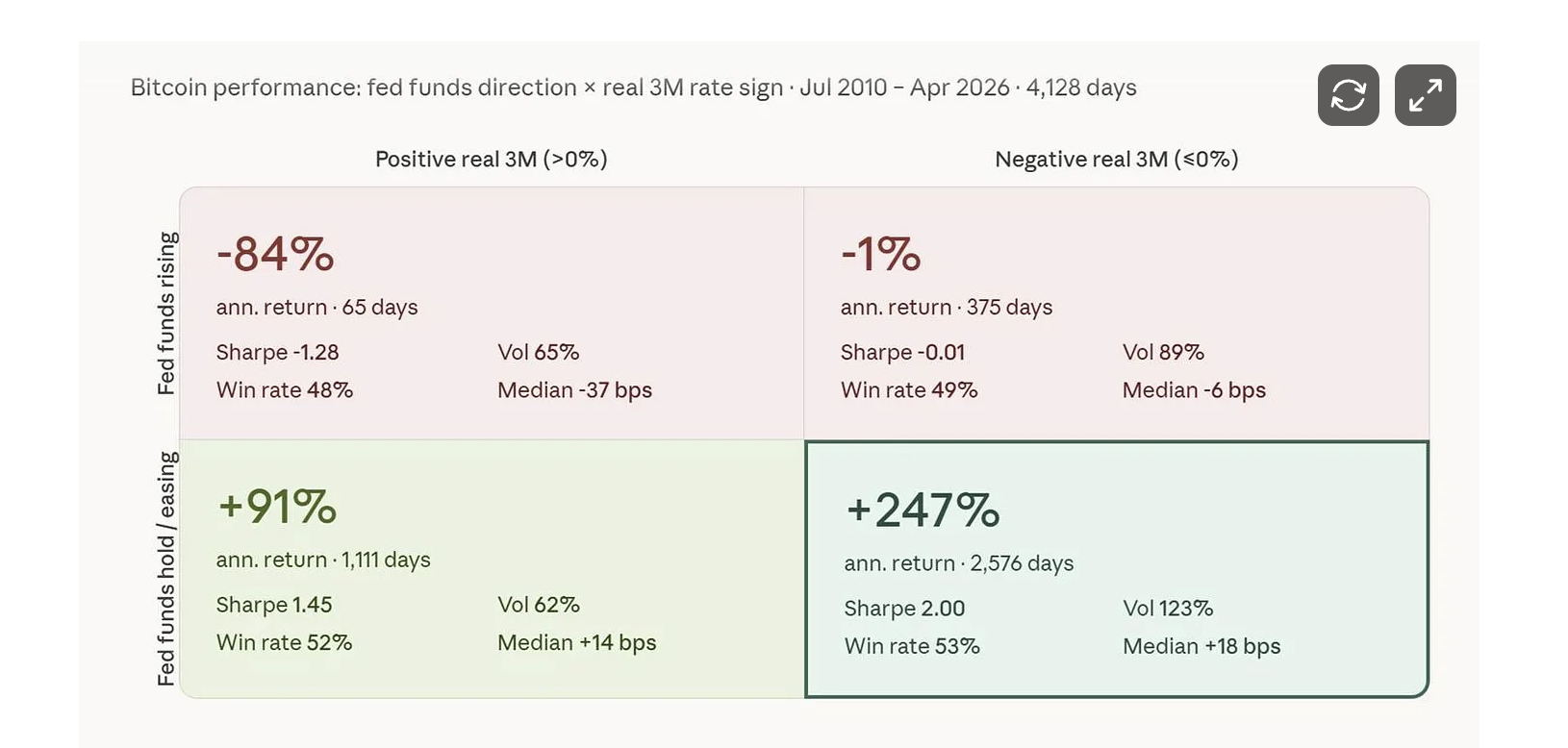
I wanted to dive more into this matrix and Bitcoin’s relationship with real yields. I found the more actionable signal may be that Bitcoin improves when the real return on cash is moving lower and becoming less restrictive rather than the real yields themselves.
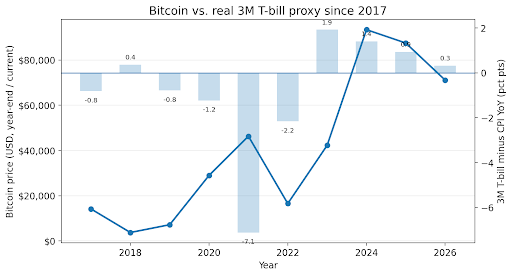
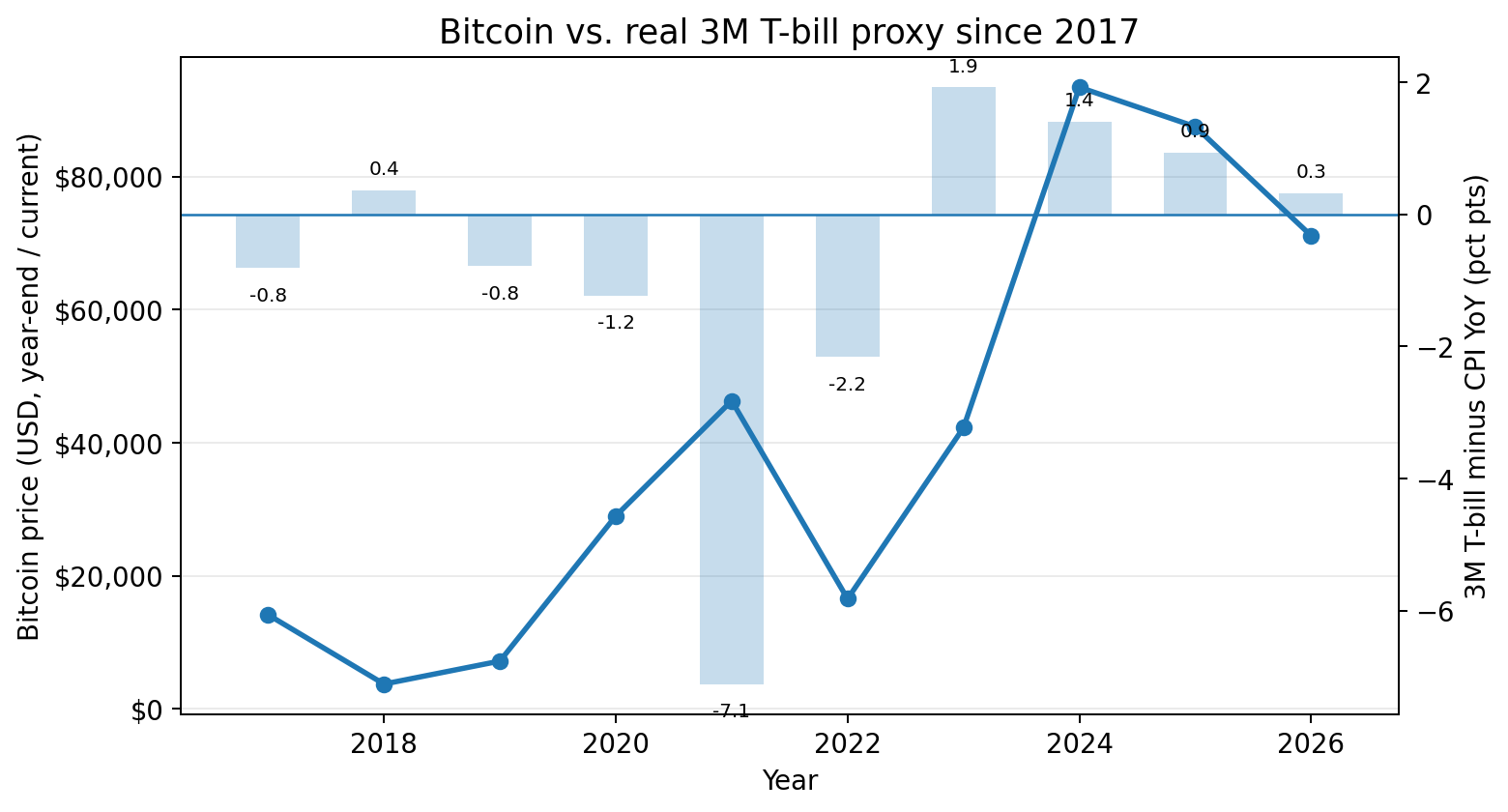
A move from strongly positive real yields to barely positive real yields can still matter. Even if cash remains nominally attractive, the opportunity cost of owning Bitcoin is no longer rising. The headwind is fading. Markets often begin repricing that change before a simple zero line is cleanly crossed.
That is why the Bitcoin-versus-real-3M chart matters so much. It does not just separate negative from positive real 3-month rates. It shows the broader arc: when the real return on cash becomes more punitive for Bitcoin, performance tends to struggle. When that pressure eases, Bitcoin tends to improve. The cleaner read is not simply negative versus positive. It is whether the real return on cash is becoming less attractive on a trend basis.
The halving narrative became canonical because the timing often looked clean enough to feel self-evident: halving, rally, peak, reset. But correlation is not causation. It is entirely possible that the halving cycle worked as a story because it repeatedly overlapped with improving liquidity conditions and a more supportive real-rate backdrop.
In that framework, the halving still matters. But it matters more as an accelerant than as the true engine.
Figure 2. Bitcoin vs. a real 3M T-bill proxy since 2017. The cleaner read is not simply negative versus positive real rates, but whether the real return on cash is becoming less attractive.
Why this may matter now
This is where the current setup becomes especially important.
The case is not that real short-term rates are already deeply negative. The case is that they may be moving toward zero quickly enough for markets to start repricing the regime before the line is cleanly crossed.
That matters because inflation is no longer a theoretical risk. March CPI rose 3.3% year over year, up sharply from 2.4% in February, while the energy index rose 12.5% over the same period. Oil is a big part of that story. After beginning the year near $61 per barrel, Brent crude finished the first quarter around $118 as conflict in the Middle East and disruption around the Strait of Hormuz pushed energy prices sharply higher.
That creates a meaningful macro tension. If energy is pushing inflation higher while the labor market softens, then the real return on cash can erode quickly even before nominal front-end rates move much. Cash does not have to become obviously unworkable overnight. It just has to become less compelling.
The Fed may also have less room to respond than in a typical inflation scare. The March FOMC minutes explicitly noted that labor-market conditions appeared vulnerable to adverse shocks and that a further drop in labor demand could push unemployment higher in a low-hiring environment.
That is where AI enters the picture. Not as a neat forecast, but as a plausible amplifier. If AI-driven productivity gains are accompanied by faster displacement in software, services, and knowledge work, then the Fed could find itself facing a difficult mix: inflation pressure through energy and physical scarcity on one side, and weaker hiring and rising unemployment on the other.
If that is the backdrop now emerging, then Bitcoin does not need perfect conditions to become more attractive. It simply needs the real return on cash to stop looking safe enough. That is the kind of inflection markets tend to price before the data look fully obvious.
This is the kind of environment Bitcoin was built for
This may be the most important point.
Bitcoin was not built for a world where cash safely preserves purchasing power, trust in policy remains high, and the monetary system feels stable and sufficient.
Bitcoin was built for the opposite.
It was built for an environment where the return on fiat money disappoints in real terms. Where monetary discipline weakens. Where holding cash feels safe nominally but destructive in purchasing power. Where investors begin to realize that scarcity matters more than promises.
That is Bitcoin’s natural habitat.
Bitcoin is fixed supply in a world of expanding balance sheets.
It is monetary certainty in a system built on discretion.
It is an asset that asks investors to step outside the logic of managed currency debasement and political convenience.
That is why the real-rate discussion matters so much. When real cash yields are rising, the system is effectively paying investors to remain inside the fiat architecture. When those real yields flatten or deteriorate, that payment weakens. The appeal of an alternative monetary asset rises.
That is when Bitcoin begins to look less like a speculative side bet and more like what it was always meant to be: scarce, apolitical money for a world where the existing system no longer feels trustworthy in real terms.
A second tell: Bitcoin may be separating from software
There is a second layer to all of this, and it may be arriving at exactly the right time.
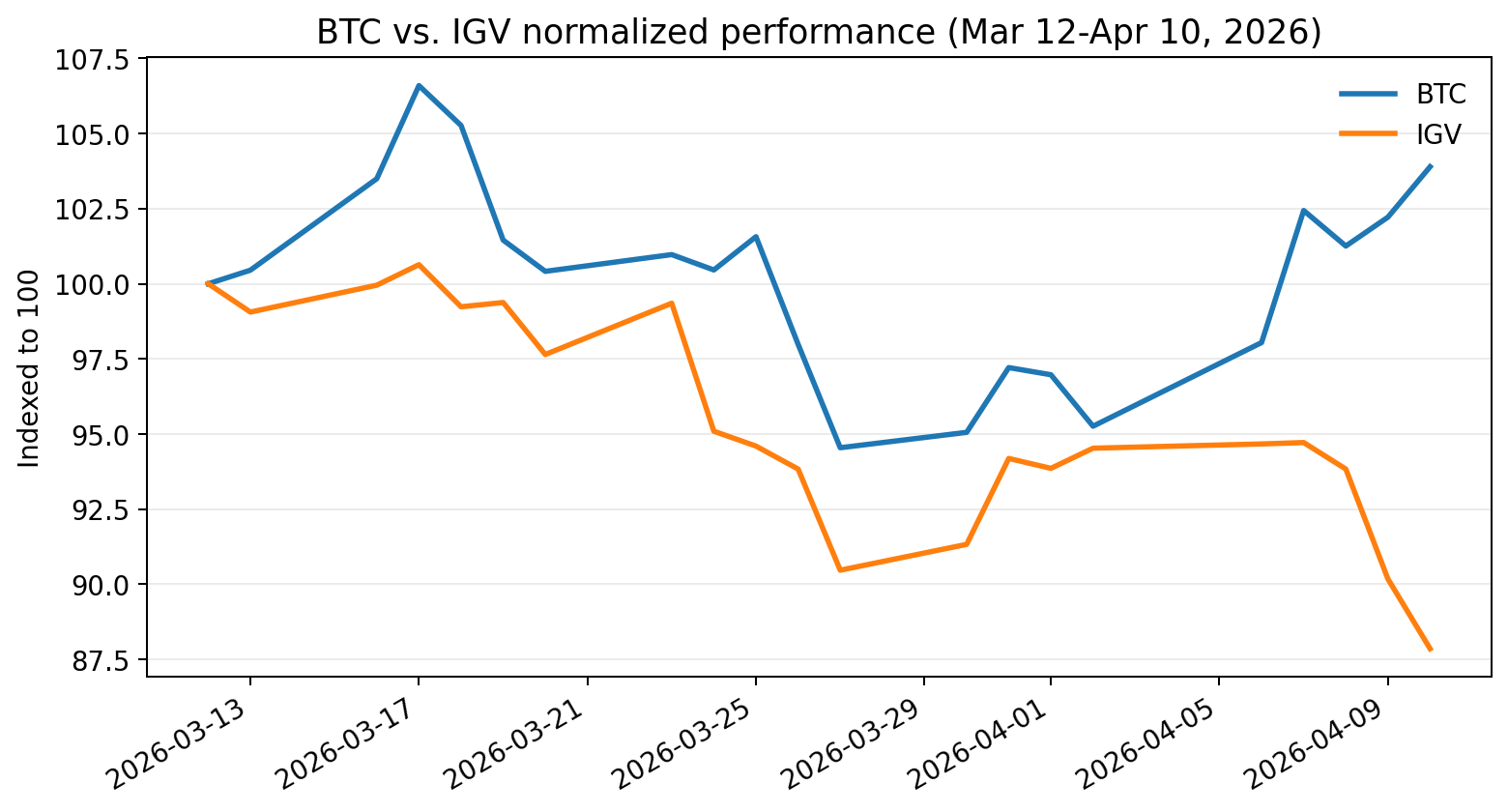
For much of the past few years, Bitcoin often traded like long-duration tech beta. That reinforced the idea that it was just another code-based risk asset.
But if Bitcoin is beginning to hold up better than software while the real return on cash deteriorates, that is a different signal.
If that relationship is changing, Bitcoin may be shifting away from the speculative tech bucket and back toward its original monetary identity: scarce digital property in a world where the return on fiat is weakening.
That would be a meaningful shift.
The takeaway
The 4-year cycle was always the easy story.
The real story may have been cash getting less attractive.
The halving mattered. But macro likely mattered more. And within macro, the direction of real short-term yields may be one of the clearest signals to watch.
If that direction is now turning lower, Bitcoin may be moving back into the kind of environment it was built for.
And if that is true, the next major move in Bitcoin may have far less to do with the calendar than people are ready for.